
Pelvic floor exercises can help reduce pelvic organ prolapse symptoms and improve the strength and function of the muscles that support the pelvic organs. When performed consistently, these exercises may help relieve pelvic pressure, improve bladder control, and enhance overall pelvic health.
Key Takeaways
- Pelvic organ prolapse often develops when the muscles and connective tissues that support the pelvic organs become weakened, leading to symptoms such as pelvic pressure, heaviness, or a vaginal bulge.
- Learning proper breathing techniques and managing abdominal pressure during daily activities can help reduce prolapse symptoms.
- Gentle exercises targeting the pelvic floor, core, hips, and surrounding muscles can improve strength and support for pelvic organs.
Understanding Pelvic Organ Prolapse
Pelvic organ prolapse occurs when one or more pelvic organs, such as the bladder, uterus, rectum, or small intestine, descend from their normal position and push against the vaginal walls. This happens when the pelvic floor muscles and connective tissues become stretched, weakened, or damaged.
Common symptoms of pelvic organ prolapse include:
- A feeling of heaviness or pressure in the pelvis
- A sensation that something is falling out of the vagina
- Visible or palpable vaginal bulging
- Difficulty emptying the bladder or bowels
- Urinary leakage
- Lower back discomfort
Pelvic organ prolapse is common, particularly after childbirth and during menopause. Research suggests that nearly half of women may experience some degree of prolapse during their lifetime.
Can Exercise Help Pelvic Organ Prolapse?
In many cases, yes.
Exercise cannot always reverse prolapse completely, especially in more advanced cases, but it can significantly improve symptoms and help prevent progression. Strengthening the pelvic floor muscles enhances support for the pelvic organs and may reduce sensations of pressure, heaviness, and vaginal bulging.
Pelvic floor physical therapy is often considered a first-line treatment for mild to moderate prolapse. Along with exercises, treatment may include education, breathing techniques, posture correction, bowel management strategies, and lifestyle modifications.
Do Kegel Exercises Help Pelvic Organ Prolapse?
Kegel exercises can be beneficial, but they are only one part of a comprehensive treatment plan.
Kegels strengthen the pelvic floor muscles and may improve prolapse symptoms, bladder control, and bowel function. However, effective prolapse management often requires additional exercises that strengthen the hips, core, glutes, and postural muscles while teaching proper breathing and pressure management.
For best results, Kegels should be combined with a well-rounded pelvic floor rehabilitation program.
Best Exercises for Pelvic Organ Prolapse
The following exercises focus on improving pelvic floor support, enhancing mobility, and managing abdominal pressure.
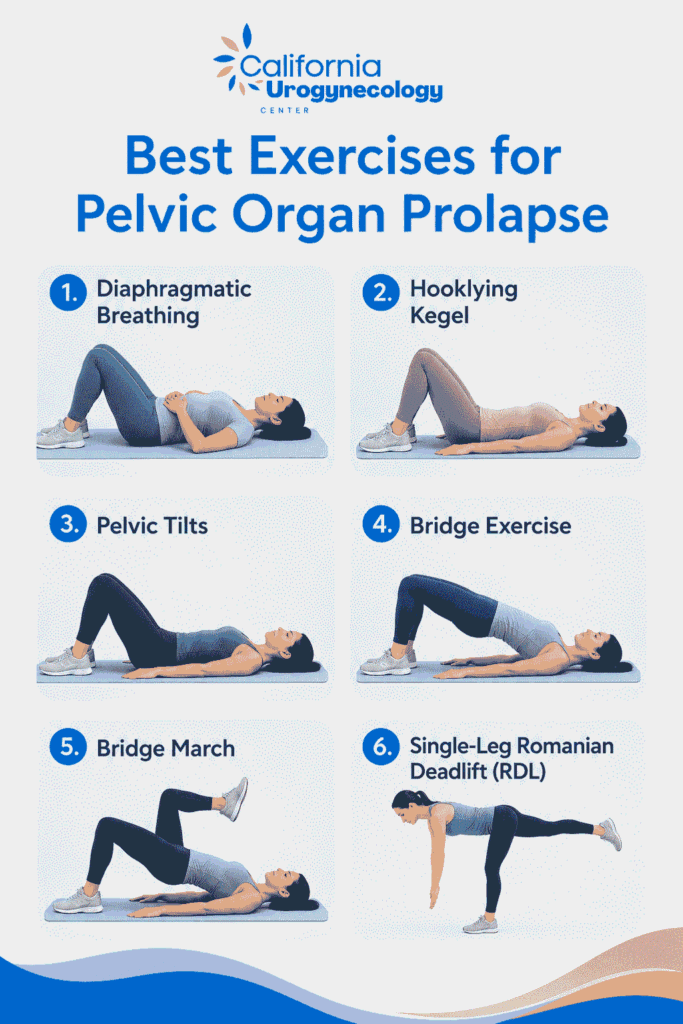
1. Diaphragmatic Breathing
Diaphragmatic breathing, also known as deep belly breathing, helps regulate pressure within the abdomen and pelvis. Proper breathing techniques can reduce strain on pelvic organs during exercise and everyday activities.
How to Perform
- Lie on your back with your knees bent and feet flat on the floor.
- Place one hand on your chest and the other on your abdomen.
- Inhale slowly through your nose, allowing your abdomen to rise.
- Keep your chest relatively still.
- Exhale slowly through your mouth and allow your abdomen to fall.
- Continue with slow, controlled breaths.
Benefits
- Reduces abdominal pressure
- Improves pelvic floor coordination
- Promotes relaxation
2. Hooklying Kegel
This exercise directly targets the pelvic floor muscles responsible for supporting the pelvic organs.
How to Perform
- Lie comfortably on your back with your knees bent.
- Gently contract the muscles around the vagina and anus.
- Imagine lifting these muscles upward inside your body.
- Hold briefly without holding your breath.
- Slowly relax and release.
Benefits
- Strengthens pelvic floor muscles
- Improves bladder and bowel control
- Enhances pelvic organ support
3. Pelvic Tilts
Pelvic tilts improve spinal and pelvic mobility while engaging the core and pelvic floor muscles.
How to Perform
- Lie on your back with knees bent.
- Allow your lower back to arch slightly away from the floor.
- Then gently flatten your lower back into the floor by engaging your abdominal muscles.
- Alternate between these two positions slowly and comfortably.
Benefits
- Activates deep core muscles
- Improves pelvic mobility
- Supports functional movement
4. Bridge Exercise
The bridge exercise strengthens the glutes, core, and pelvic floor while promoting proper breathing during movement.
How to Perform
- Lie on your back with knees bent and feet flat on the floor.
- Press through your heels and lift your hips toward the ceiling.
- Squeeze your glute muscles at the top.
- Slowly lower your hips back down.
Benefits
- Strengthens glutes and core
- Improves pelvic stability
- Encourages pressure management during movement
5. Bridge March
Bridge marching adds a balance and stability challenge while strengthening the hips and core.
How to Perform
- Begin in the bridge position with hips elevated.
- Lift one foot off the floor while maintaining pelvic stability.
- Lower the foot and repeat on the opposite side.
- Keep your hips level throughout the exercise.
Benefits
- Improves hip strength
- Enhances single-leg stability
- Reduces excessive strain on the pelvic floor
6. Single-Leg Romanian Deadlift (RDL)
This functional exercise strengthens the posterior chain, including the glutes, hamstrings, and lower back.
How to Perform
- Stand upright with feet hip-width apart.
- Shift weight onto one leg.
- Hinge forward at the hips while extending the opposite leg behind you.
- Keep your spine neutral throughout the movement.
- Return slowly to standing.
Benefits
- Builds hip and glute strength
- Improves balance and coordination
- Supports everyday lifting activities
Why Proper Breathing Matters
One of the most important aspects of managing pelvic organ prolapse is learning how to control abdominal pressure.
Holding your breath during lifting, exercise, coughing, or bowel movements can increase downward pressure on the pelvic organs. Instead, focus on exhaling during the effort phase of a movement.
For example:
- Exhale while standing up from a chair.
- Exhale while lifting groceries.
- Exhale during the exertion phase of exercise.
This simple habit can help reduce strain on the pelvic floor and support long-term symptom management.
When to Seek Professional Help
While exercise can be highly effective for many individuals with pelvic organ prolapse, some cases may require additional treatment. If symptoms persist, worsen, or significantly affect your quality of life, consult a urogynecologist or pelvic floor physical therapist for a personalized evaluation.
Treatment options may include pelvic floor therapy, pessary fitting, lifestyle modifications, or surgical intervention depending on the severity of the prolapse.
Find Relief with Expert Pelvic Floor Therapy in Riverside
You don’t have to live with the discomfort and uncertainty of pelvic organ prolapse. Through specialized pelvic floor therapy in Riverside, many women find meaningful relief and improve their quality of life without surgery.
Led by Dr. Bilal Kaaki, California Urogynecology Center offers compassionate, individualized care for women throughout Riverside, CA. Contact our office today to schedule an evaluation and begin your journey toward stronger pelvic health.
References
- Aboseif, C., & Liu, P. (2021). Pelvic Organ Prolapse. PubMed; StatPearls Publishing. https://www.ncbi.nlm.nih.gov/books/NBK563229/
- Ansari, Md. K., Sharma, P. P., & Khan, S. (2021). Pelvic Organ Prolapse in Perimenopausal and Menopausal Women. The Journal of Obstetrics and Gynecology of India, 72(3), 250–257. doi:10.1007/s13224-021-01524-8
- Carroll, L., O’ Sullivan, C., Doody, C., Perrotta, C., & Fullen, B. (2022). Pelvic organ prolapse: The lived experience. PLOS ONE, 17(11), e0276788. doi:10.1371/journal.pone.0276788
- Giri, A., Hartmann, K. E., Hellwege, J. N., Velez Edwards, D. R., & Edwards, T. L. (2017). Obesity and pelvic organ prolapse: a systematic review and meta-analysis of observational studies. American Journal of Obstetrics and Gynecology, 217(1), 11-26.e3. doi:10.1016/j.ajog.2017.01.039
- Iglesia, C. B., & Smithling, K. R. (2017). Pelvic Organ Prolapse. American Family Physician, 96(3), 179–185. https://www.aafp.org/pubs/afp/issues/2017/0801/p179.html